

Modern daily life is incredibly demanding on the human body, forcing most of us into sedentary positions for hours at a time. Whether you are sitting at an office desk, driving through morning traffic, or relaxing on the couch at home, your body is constantly adapting to the positions you hold. Over time, these repetitive positions solidify into subconscious habits that can cause chronic aches, joint stiffness, and severe muscular imbalances.
Common posture mistakes are often ignored until they eventually manifest as debilitating neck strains, headaches, or nagging lower back pain. Many people assume that bad posture is simply a personal aesthetic flaw or a minor habit that can be corrected by just trying to “sit up straight” once in a while. In reality, poor alignment alters how your muscles contract and places immense, unnatural pressure on your spinal discs and ligaments.
Fixing these common posture mistakes requires more than just willpower; it requires understanding exactly what you are doing wrong throughout the day and how to systematically reverse the damage. By identifying these daily patterns, you can actively protect your joints and move pain-free. Let’s look closely at five of the most frequent structural alignment errors people make every single day and the exact, physiotherapist-approved methods to fix them.
1. The Forward Head Posture (Also Known as “Tech Neck”)
Common posture mistakes almost always begin at the top of the spine with the way we position our heads while looking at digital devices. When you peer at a computer screen or lean down to look at your smartphone, your chin naturally drifts forward, pulling your head off its center of balance. For every single inch your head moves forward past your shoulders, it adds an extra 10 pounds of pressure that the muscles in your neck and upper back must actively hold up.
How to fix this mistake: You can easily correct this by practicing a daily exercise known as the “chin tuck.” Sit up straight, look straight ahead, and gently pull your chin straight backward as if you are trying to make a double chin. Hold this position for 5 seconds and repeat it 10 times to strengthen the deep muscles in the front of your neck. Additionally, bring your phone up to eye level instead of lowering your head to look at your lap.
2. Slouching and Rounding the Shoulders Forward
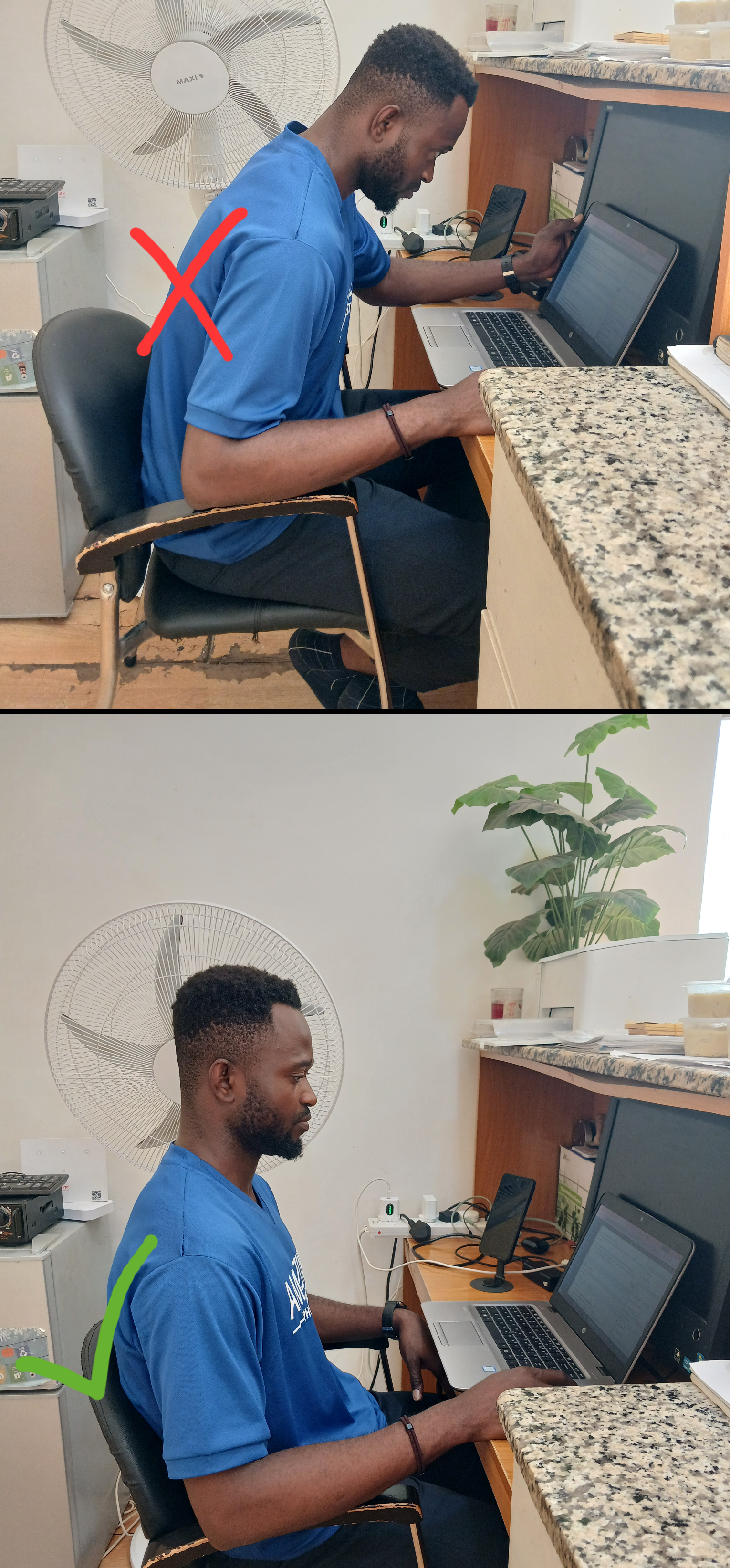
Common posture mistakes frequently involve a structural collapse of the upper torso, causing the shoulders to roll forward and the upper back to curve like a ball. This specific position usually happens when your chest muscles (the pectorals) become incredibly tight and short from hours of typing, while the muscles in your upper back become overstretched, weak, and completely inactive.
How to fix this mistake: You must actively open your chest and wake up your upper back muscles to reverse this rounding.
Place your hands behind your head, gently pull your elbows back as far as possible, and squeeze your shoulder blades together tightly for 10 seconds. Doing this simple chest-opening stretch every hour resets your shoulder position and instantly takes pressure off your upper spine.
3. Slouching from the Lower Back (The Slumped Sit)
Common posture mistakes are heavily visible in the lower spine when people completely slide forward in their office chairs. Instead of sitting directly on their sit bones, many individuals slump down so low that they are actually resting their body weight directly on their sacrum and lower lumbar vertebrae. This position completely flattens the natural, healthy curve of your lower back, overstretching the protective ligaments and compressing your spinal discs.
How to fix this mistake: You need to change how you sit by pushing your hips all the way to the very back of your chair before letting your spine rest. If your chair does not offer built-in lumbar support, roll up a small bath towel and place it directly behind the small curve of your lower back to maintain your spine’s natural shape. Ensure your feet are resting flat on the floor to evenly distribute your weight.
4. Text Neck While Standing Up and Walking
Common posture mistakes do not just happen while you are sitting down; they easily bleed into your standing and walking habits. Many people walk around with their eyes completely glued to their phones, rounding their entire upper backs, dropping their chests, and letting their arms hang forward loosely. This walking style creates a massive imbalance that forces your lower back and hip muscles to overcompensate just to keep you upright and moving forward.
How to fix this mistake: You should focus on walking with an open, proud posture by imagining a string attached to the very top of your head pulling you up toward the ceiling. Keep your eyes looking forward at the horizon rather than down at the ground, and actively let your arms swing naturally by your sides. If you must read a text message while walking, stop moving completely, step to the side, and bring the phone up to your eyes.
5. Leaning Heavily onto One Hip While Standing
Common posture mistakes are highly evident when people are forced to stand in one place for long periods, such as waiting in a line. Instead of distributing their body weight evenly across both feet, most people will automatically shift all of their weight over to one preferred leg, letting their opposite hip drop down completely. This asymmetrical leaning places a massive, unequal strain on one side of your pelvis and forces your lower back muscles to work double-time to keep you balanced.
How to fix this mistake: You must train yourself to stand with your feet spaced roughly hip-width apart, consciously placing an equal 50/50 split of your body weight through both heels. If you feel tired while standing for long periods, gently squeeze your glute (buttock) muscles to stabilize your pelvis, or take a short walk to keep the blood flowing through your joints rather than sinking into one hip.
The Golden Rule: Your Next Posture is Your Best Posture
Fixing your body’s alignment isn’t about freezing yourself into a rigid, military-straight position all day long. The human body is designed to move, and holding any position for too long will eventually cause discomfort.
The ultimate solution to avoiding structural pain is movement. Try to break up your sitting blocks every 45 minutes by standing up, stretching, or walking around the room for two minutes. Click here for more articles on posture Mistake
Are posture habits causing you daily pain?
If you have been practicing these poor habits for years, your muscles might be too tight or too weak to fix on your own.
If you are struggling with nagging neck or back pain, let us help you build a personalized corrective roadmap. Click HERE to schedule a comprehensive posture assessment with our physiotherapy clinic today, and let’s get your body back in perfect alignment!

Leave A Comment